

About the Tata Group
Founded by Jamsetji Tata in 1868, the Tata Group is a global enterprise, headquartered in India, comprising 31 companies across multiple verticals. The group operates in more than 100 countries across six continents, with a mission 'To improve the quality of life of the communities we serve globally, through long-term stakeholder value creation based on Leadership with Trust’.
Tata Sons is the principal investment holding company and promoter of Tata companies. Sixty-six per cent of the equity share capital of Tata Sons is held by philanthropic trusts, which support education, health, livelihood generation and art and culture.
In 2024-25, the aggregate revenue of Tata companies was more than $180 billion. These companies collectively employ over one million people.
Each Tata company or enterprise operates independently under the guidance and supervision of its own board of directors. There are 26 publicly listed Tata companies with an aggregate market capitalisation of more than $328 billion as on March 31, 2025.
About Air India
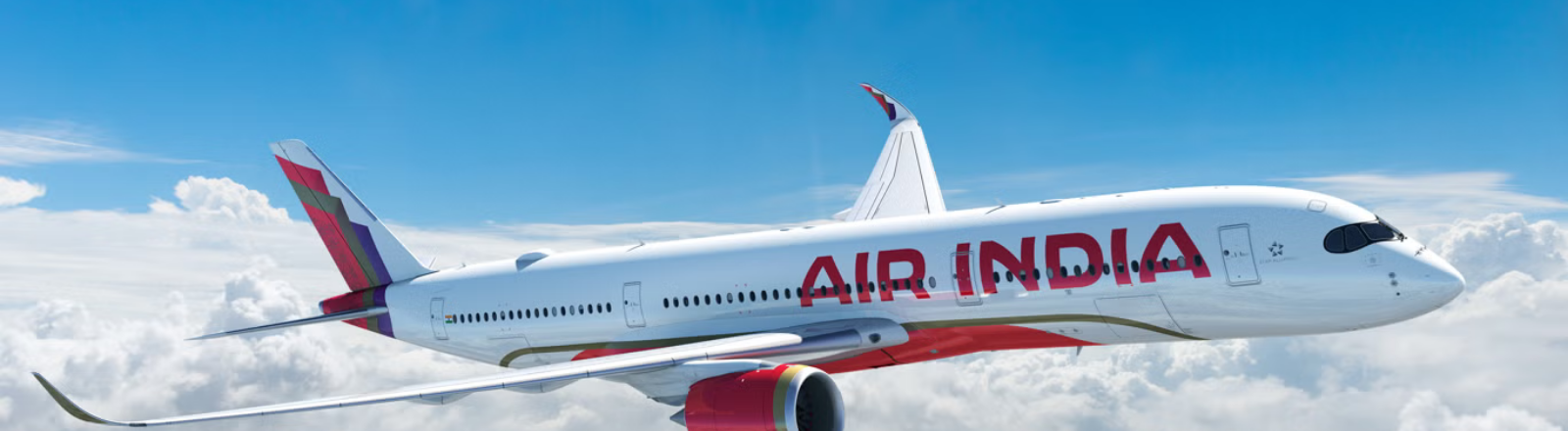
Founded by the legendary JRD Tata, Air India pioneered India’s aviation sector. The airline's history is, in fact, synonymous with the history of civil aviation in India.
Since its first flight on October 15, 1932, Air India has spread its wings to become a major international airline with a network across the United States, Canada, United Kingdom, Europe, Asia, Australia, and the Persian Gulf.
The airline also has an extensive domestic network, including India’s northeast, Ladakh, and the Andaman & Nicobar Islands. Air India has been a member of Star Alliance, the largest global airline consortium, since July 2014.
Air India Express, a subsidiary of Air India, is India's first international budget carrier, Air India Express was launched in 2005 to meet the demand for affordable services on short and medium-haul routes connecting smaller towns in India directly to the Gulf and southeast Asian regions.
Air India, along with Air India Express, plays a pivotal role in serving the nation in times of crisis. In various epic missions, Air India and Air India Express flights evacuated stranded people from all over the world in the aftermath of the Covid-19 outbreak through the Government of India's Vande Bharat Mission and Air Transport Bubble flights.
The consolidation of the four Tata-owned airlines into one Group operating one full-service and one low-cost airline is part of the ongoing, five-year transformation program, Vihaan.AI, which is focussed on establishing Air India Group as a world-class global aviation company with an Indian heart.
The unified Air India Group now operates over 8,300 weekly flights on 312 routes, connecting more than 100 domestic and international destinations with a fleet of 300 aircraft.
The new full-service entity Air India operates over 5,600 weekly flights and connects more than 90 domestic and international destinations with a fleet of 208 aircraft. The airline will now be flying over 120,000 passengers every day and offers an extended worldwide connectivity to over 800 destinations through more than 75 codeshare and interline partners.
Preparation for the full-service merger commenced in earnest more than two years ago and has seen the induction of more than 6,000 staff from Vistara into a new organisation structure, harmonisation of operating procedures across the four airlines, and alignment of over 140 IT systems. Amongst many other aspects, more than 4,000 vendor contracts have been consolidated, 270,000 customer bookings migrated and 4.5 million Club Vistara frequent flyer accounts inducted to Air India’s recently-redesigned frequent flyer program, Maharaja Club.
Given the unprecedented nature and complexity of the parallel mergers, which coincide with the Group’s significant expansion and transformation programs, close contact was maintained with India’s Directorate General of Civil Aviation (DGCA) which supported and monitored the process throughout. The merger also received support from the Ministry of Civil Aviation (MoCA), Bureau of Civil Aviation Security (BCAS) and other key stakeholders, including multiple international regulators.
Besides the consolidation of the four Tata-owned airlines, the Vihaan.AI transformation program has seen commitment to more than 500 new aircraft, delivery of which is well underway, and the commencement of a USD 400 million interior retrofit program for legacy aircraft. A new 600,000 square feet training facility with the capacity to train 2,000 employees per-day has been opened, and ground has been broken on a 12-bay maintenance base that will be operational in early 2026. More than 9,000 new employees have been inducted and trained, and the airlines’ IT platform has been entirely modernised, amongst much else.

Air India Newsroom
Air India's Newsroom, which serves as a vital resource for informing and educating people about the latest updates and developments related to the airline. This newsroom provides a centralized platform where the airline shares news articles, press releases, and updates on new routes, services, fleet expansions, partnerships, and technological innovations. By regularly updating this section, Air India ensures transparency and keeps customers, stakeholders, and the general public informed about its growth and improvements. It also highlights any special events, corporate announcements, and industry collaborations, thereby fostering trust and engagement with the audience. Overall, this newsroom acts as an educational tool by providing comprehensive, timely information that helps people stay connected with Air India's progress and initiatives.
Powered by
